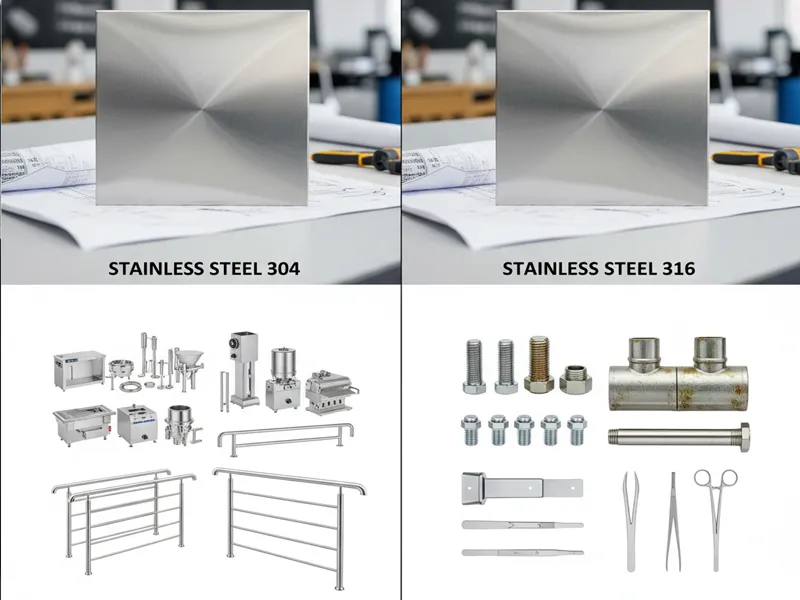
It is widely known that Grade 316 offers better corrosion resistance than Grade 304. However, in the construction and fabrication industry, certain misconceptions can lead contractors to order materials that are either overly expensive (Over-Spec) or dangerously inadequate (Under-Spec). In this article, Trinity Dynamic debunks 5 common myths about these two popular stainless steel grades to save you from costly mistakes.
Myth 1: "Grade 316 Stainless Steel Will Never Rust" (False!)
While earning the nickname "Marine Grade," 316 stainless steel can and will rust if subjected to highly concentrated corrosive chemicals or if salt spray is allowed to build up unwashed over a long period. Regular fresh-water washing is still required even in coastal areas to prevent surface staining.
Myth 2: "All Outdoor Jobs Must Use Grade 316" (Not Always)
Many contractors specify 316 "just to be safe." However, if your project is located more than 5 kilometers inland, away from harsh coastal air or heavy industrial pollution, Grade 304 plates will perform flawlessly for decades. Unnecessarily upgrading to 316 is a guaranteed way to bloat your project budget.
Myth 3: "If a Magnet Sticks, It's Fake 304" (Exceptions Apply)
Grades 304 and 316 are Austenitic, meaning they are non-magnetic in their annealed (unworked) state. However, when the steel undergoes Cold Working (bending, rolling, or deep drawing), the molecular structure at the stress points shifts, causing it to become mildly magnetic. This is normal metallurgy, and the material is still 100% genuine stainless steel.
Myth 4: "Grade 316 is Structurally Stronger Than 304" (False)
When it comes to mechanical strength (Yield and Tensile Strength), Grade 304 and 316 are virtually identical. The premium price you pay for Grade 316 is not for "extra hardness," but for the addition of Molybdenum, which drastically increases its corrosion resistance.
Myth 5: "Cheap 304 Means Low Quality" (Depends on the Source)
The phrase "cheap stainless steel" might sound alarming if you are buying undocumented metal, as it could be mislabeled Grade 201. However, at Trinity Dynamic, we offer wholesale pricing on genuine ASTM A240 certified stainless steel. Our materials come with fully traceable Mill Test Certificates (MTC), proving that you can get both "low price" and "high quality."
The Verdict Table: 304 vs 316
| Project Type / Environment | Recommended Grade | Cost Level |
|---|---|---|
| Interior Decor, Kitchenware, Indoor Furniture | Stainless 304 | Most Economical |
| Balustrades, Fencing, Freshwater Systems | Stainless 304 / 304L | High Value (Most Popular) |
| Swimming Pools, Coastal Areas, Pharma Plants | Stainless 316 / 316L | Premium (Durability Focused) |
| Chemical Refineries, Acid Tanks, Wastewater | Stainless 316L | Highest (Maximum Safety) |
Confused About Which Stainless Grade to Specify?
Don't let myths increase your project costs or risk safety. Let Trinity Dynamic's expert sales team analyze your specific needs and provide the most cost-effective quotation for Grade 304 / 316L Plates & Coils.
Request a Free Technical Consultation